Safety of Escalators and Moving Walkways
18. January 2023·Technická inšpekcia, a.s.
This article explains the basic safety principles for escalators and moving walkways, considering regulations and the risks affecting passengers.
Escalators and moving walkways are lifting devices used for transporting people between different height levels, offering the highest transport capacity compared to other lifting devices. The operating principle of escalators and moving walkways involves a motor-driven chain of interconnected steps, belts, or pallets that cyclically move along a fixed path. Practically, it is a chain conveyor, similar to those designed for cargo transport in manufacturing plants. In most cases, they are installed in locations where installing elevators would be impractical. They are most commonly found in airports, subways, large department stores, major transportation hubs, and similar venues.
Currently manufactured and installed escalators and moving walkways must comply with numerous safety regulations – applicable requirements from Annex I of European Parliament and Council Directive No. 2006/42/EC on machinery, and the requirements of standards for escalators and moving walkways. Despite strict requirements, escalators and moving walkways are among the lifting devices that account for a high number of accidents across Europe.
For a better understanding of the terminology related to escalators and moving walkways, Figure 1 illustrates the basic parts of an escalator.
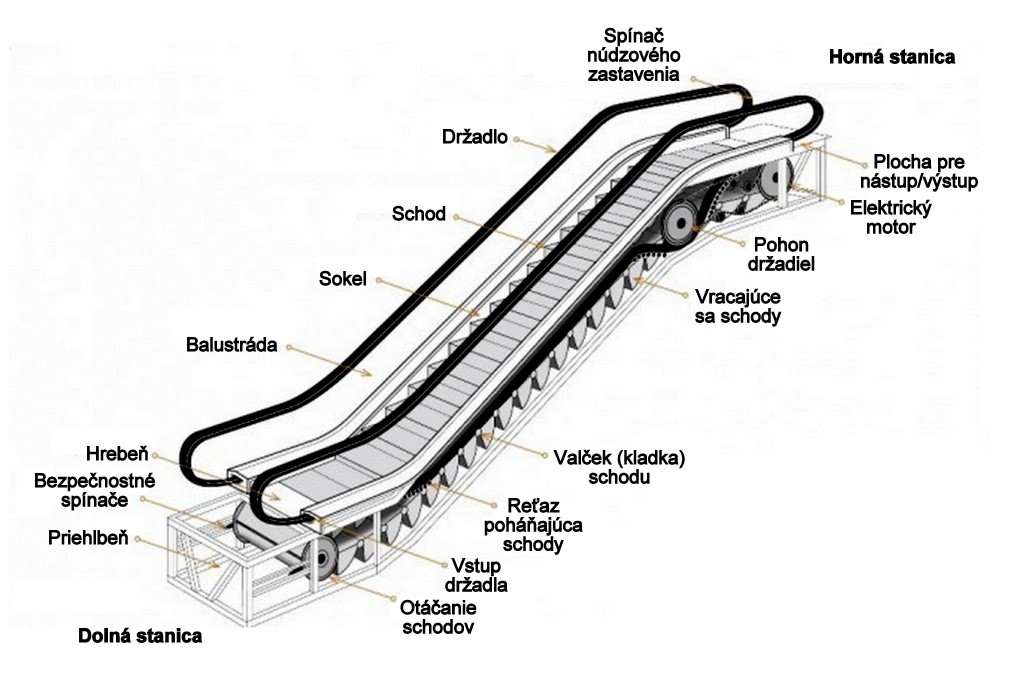
Figure No. 1: Basic parts of escalators (source: http://jeiles.com/escalator)
Technical Regulations Applicable to Escalators and Moving Walkways
As mentioned above, escalators and moving walkways must currently meet at least the requirements specified in Annex I of European Parliament and Council Directive No. 2006/42/EC on machinery, which was transposed into Slovak legislation as Government Regulation of the Slovak Republic No. 436/2008 Coll. Older escalators and moving walkways within the European Union had to comply with Council Directive No. 93/44/EEC, which supplemented the first Machinery Directive No. 89/392/EEC. The subsequent issue of the Machinery Directive No. 98/37/EC was already transposed by the Slovak Republic through Government Regulation of the Slovak Republic No. 391/1999 Coll. Before the adoption of this regulation, escalators and moving walkways in the Slovak Republic were manufactured, installed, and put into operation solely based on valid Slovak Technical Standards (STN).
Below is an overview of the standards used for escalators and moving walkways, chronologically ordered by publication date. This year, the latest standard STN EN 115-1:2018 – Safety of escalators and moving walkways. Part 1: Construction and installation, was published, which applies to new escalators and moving walkways. This standard contains several significant changes compared to the original standard STN EN 115-1+A1:2010. The biggest changes concern functional safety, control and safety circuits, as well as the reliability of the entire system.
For existing escalators and moving walkways, the best option is to use standard STN EN 115-2:2010, which establishes rules for improving the safety of existing escalators and moving walkways. This standard can be used to perform an analysis of the technical condition of existing escalators and moving walkways, the result of which identifies parts of these devices designated for replacement or modification to reduce existing risks.
Standards related to escalators and moving walkways include:
Safety Level of Escalators and Moving Walkways
The safety of escalators and moving walkways is a frequently discussed topic across Europe. Existing escalators and moving walkways in the Slovak Republic can be divided into three basic groups: the first group consists of escalators and moving walkways that were designed and manufactured according to Slovak standards before the effectiveness of Government Regulation (NV) of the Slovak Republic No. 391/1999 Coll. The second group includes escalators and moving walkways designed and manufactured in accordance with European Directive 98/37/EC (transposed in the Slovak Republic into NV SR No. 391/1999 Coll.), which began to apply in the Slovak Republic from January 1, 2000, when the Slovak Republic adopted EU legislation and European standards. In 2004, NV SR No. 391/1999 Coll. was replaced by NV SR No. 310/2004 Coll., which also transposed the aforementioned Directive 98/37/EC, among other regulations. Escalators and moving walkways designed and manufactured according to Machinery Directive 2006/42/EC (transposed in NV SR No. 436/2008, which came into effect on December 29, 2009) represent the third group of these devices, for which the latest regulations and standards apply.
It is logical that the safety level of escalators and moving walkways decreases with the increasing age of these devices (Fig. 2). Escalators and moving walkways manufactured according to the latest regulations and standards therefore have the highest level of safety. However, this statement applies provided that the device is properly maintained (timely replacement of worn parts, adjustment and inspection of sensors and switches, etc.) and prescribed inspections and tests are carried out.
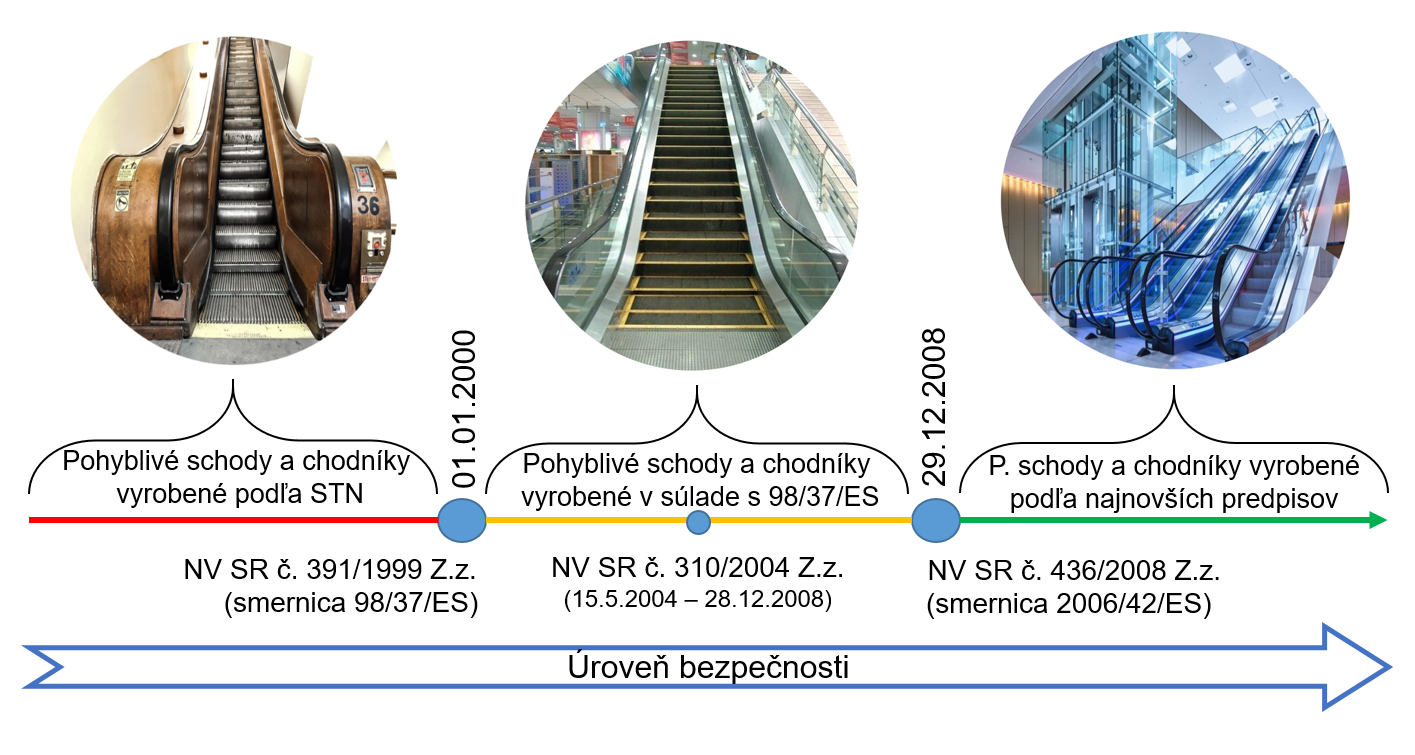
Figure No. 2: Classification of escalators and moving walkways in the Slovak Republic by safety level (source: author)
From a safety perspective, increased attention must be paid to escalators and moving walkways that were designed and manufactured according to STN standards in the last century (mentioned as the first group) and are more than 25 years old. For such devices, it is recommended to apply standard STN EN 115-2:2010 as soon as possible to increase their safety. Such devices may be in good technical condition and meet all requirements of regulations valid at the time of commissioning; however, residual risks are generated that are more numerous and serious compared to the latest escalators and moving walkways.
Eliminating or reducing residual risks is a fundamental task in terms of technical equipment safety. The use of escalators and moving walkways generates a relatively high number of potentially dangerous situations. The continuously increasing number of accidents when using escalators or moving walkways serves as proof.
The most common and serious hazards associated with the use of escalators and moving walkways for passengers include:
Increasing the Safety of Existing Escalators and Moving Walkways
As we have already mentioned, attention should be paid to increasing the safety of existing escalators and moving walkways. More than half of the escalators and moving walkways in Europe were installed in the last century. Therefore, standard STN EN 115-2:2010 was adopted, which establishes rules for improving the safety of existing escalators and moving walkways. Within Europe, it is the only technical document that addresses the issue of safety for older escalators and moving walkways. Based on risk assessment, this standard categorizes various risks and hazardous situations and also lists risks and corrective measures that can be gradually implemented.

 Methods for Increasing the Safety of Existing Elevators